

DILO products for gas analysis & detection
For clear values. And maximum safety.
Whether during commissioning, operation or for regular control: Manufacturers and operators of gas-insulated systems need reliable information about the condition of the arc quenching and insulating gases in their systems at all times. DILO supplies a complete range of devices for detecting gases and analysing gas purity, moisture, mixing ratio, decomposition products and other parameters.
Systematic analysis & detection
From one-time measurement to continuous monitoring and precise laboratory analysis: Reliable technology and uncompromising precision are essential both for analysis and detection. That is why DILO's product portfolio covers every step of the way: from portable devices for flexible use on site to stationary systems for continuous operation. All solutions have one thing in common: They are specially designed for applications in the medium and high voltage range and deliver standardised, precise and reproducible results at all times.

With the aim of making a significant contribution to the global energy transition, we are actively working on the development of user-friendly technologies for emission-free industrial gas handling.
Measuring devices
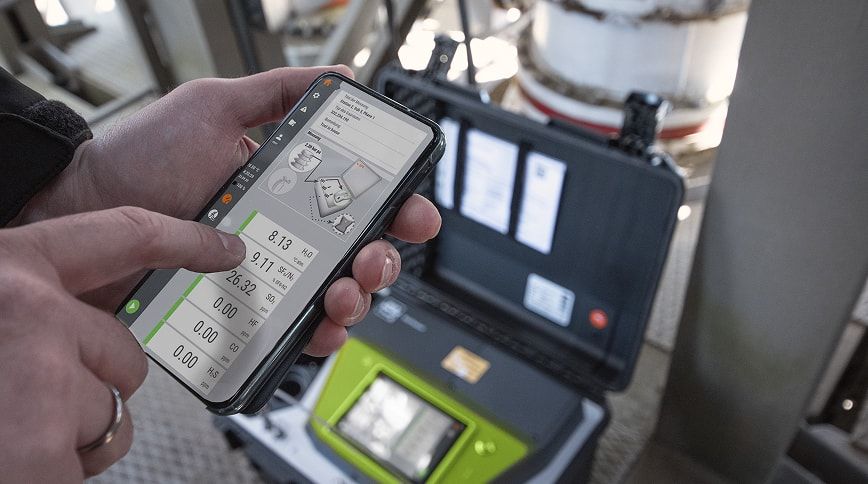
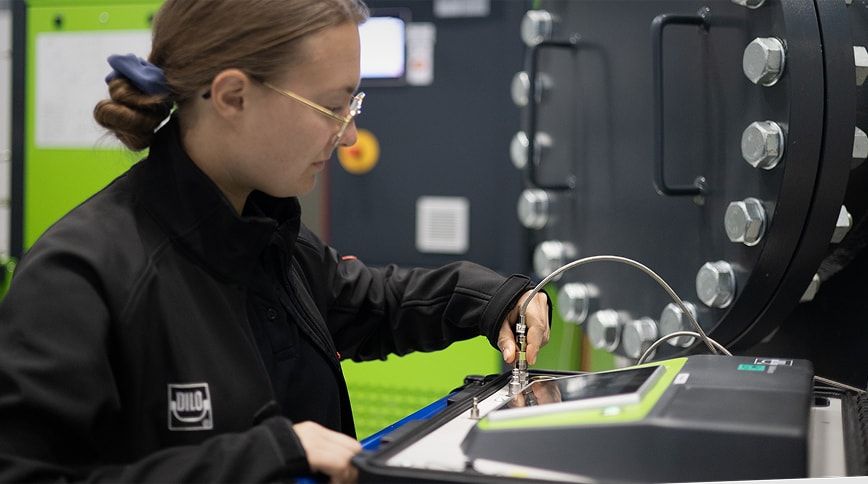
When accurate data is crucial: DILO measuring devices enable precise and standard-compliant analysis of key gas parameters, with the flexibility of on‑site measurement. If required, further relevant values can be determined in the DILO laboratory.
FAQ – Gas analysis
What you need to know
If you have any further questions, please do not hesitate to contact our customer service team.
Why is moisture in SF₆ gas a critical parameter?
Moisture accelerates the decomposition of SF₆ and promotes corrosion and ice formation inside the system. It can also deliver undesirable secondary decomposition products, which can lead to arcing and equipment failure. Continuous or spot moisture measurement is therefore a key component of any gas condition assessment.
How does the dew point mirror method for moisture measurement work?
A cooled mirror is cooled within the gas flow until condensation (dew or ice) forms. The mirror temperature measured in this process corresponds to the dew point or frost point. This physical measurement principle is considered particularly reliable and accurate and, alongside capacitive measurement, is one of the two standard methods.
What limit values apply to moisture and purity in SF₆ systems?
According to IEC 60376, the specified atmospheric dew point is −36 °C. Other standards sometimes specify 120 ppmv at −40 °C for refilling, whilst the American standard ASTM D2472-92 is stricter, at 71 ppmv at −45 °C. For existing GIS systems, a limit of ≤ 200 ppmv is frequently cited.
What decomposition products are formed during switching operations, and why are they problematic?
Over time, arcing and discharges in SF₆ give rise to toxic and highly corrosive decomposition products (including SO₂ and HF). These substances pose a health risk and are also harmful to the materials in the system. Monitoring them is therefore important from both a safety and a maintenance perspective. Furthermore, these decomposition products can form corrosive media when combined with moisture.
What different measurement principles are used to determine SF₆ gas quality?
In addition to the dew point method for measuring moisture, the main techniques used are electrochemical sensors (for decomposition products such as SO₂) and the measurement of the speed of sound. The latter is used to determine the mixing ratio or purity, as different gases have different speeds of sound. Combining several methods in a single device makes it possible to measure multiple quality parameters in a single measurement.
Gas detection devices
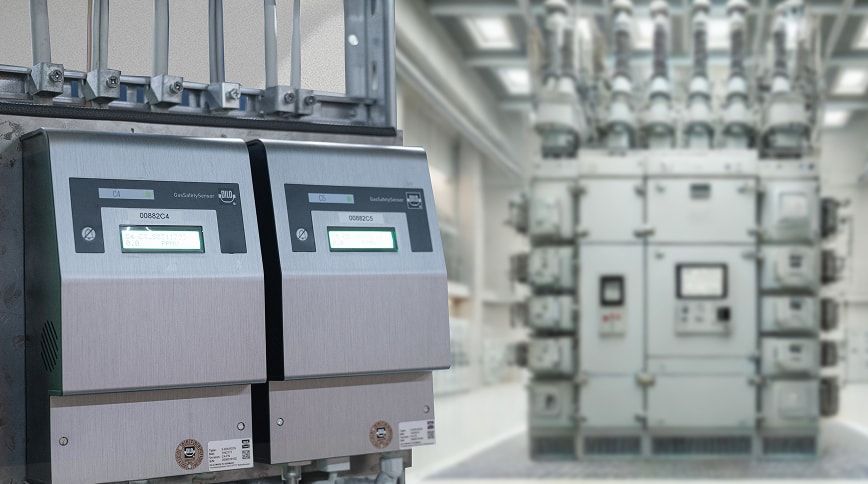
When quick gas detection matters: Portable or stationary detectors from DILO reliably localise even the smallest leaks and thus ensure maximum safety for users and systems, while actively protecting the environment.
FAQ – Gas detection
What you need to know
If you have any further questions, please do not hesitate to contact our customer service team.
What are the permissible leak rates for SF₆ systems?
For new installations, the permissible leak rate is usually 0.5 per cent per year or less. It is an important reference value against which operators compare the results of their leak detection tests in order to classify installations as leak-tight or in need of maintenance. However, this leak rate is only a theoretical value, as determining it is very labour-intensive. According to the EU F-Gas Regulation (EU) 2024/573 (Article 4(5)), any detected leak must be repaired immediately. For installations subject to leak testing, the success of the repair must also be verified by a certified person no earlier than 24 hours after operation has commenced, but no later than one month thereafter. Electrical switchgear does not need to be checked for leaks under Article 5 if its tested leakage rate is below 0.1 per cent per year (according to the manufacturer’s technical specifications and labelling) or if a sensor for monitoring pressure or gas density with an automatic warning system is fitted.
What measurement principles are used in leak detection?
Among others, NDIR (non-dispersive infrared) sensors are widely used; these measure the infrared absorption of SF₆ and are insensitive to environmental influences such as humidity or VOCs. Negative Ion Capture (NIC) technology is also widely used; it is characterised by high sensitivity and continues to operate without any loss of sensitivity even after exposure to high gas concentrations.
What is the difference between point-based and area-based leak detection?
Portable detectors are moved systematically along suspected leak points (e.g. flanges, seals). Stationary systems, on the other hand, continuously monitor the air in enclosed spaces containing switchgear and trigger an alarm when a threshold value is reached. This is particularly relevant for health and safety in switchgear rooms.
How sensitive are modern SF₆ leak detectors?
Depending on the technology and intended use, sensitivity ranges from a few ppm to the ppb range. Some stationary systems can detect leaks of just a few ppb of SF₆ in the air within large switchgear rooms.
Why is attention paid to ‘emission-free’ measurement and detection when handling SF₆?
SF₆ is a gas with an extremely high global warming potential (GWP of 24,300 according to the current EU F-Gas Regulation (EU) 2024/573) and is therefore strictly regulated. Consequently, no gas must be deliberately released, even during leak detection. Detection methods are therefore designed to operate passively, whilst recirculation systems (re-pumping, collection tanks) are used during accompanying maintenance work.
Is SF₆, or are its decomposition products, a hazardous substance, and what does this mean for health and safety during detection?
SF₆ itself is not classified under the CLP Regulation; however, it is nevertheless regarded as a hazardous substance under the Hazardous Substances Ordinance, as an occupational exposure limit has been assigned to it. The decomposition products, in particular, pose a health risk. For this reason, continuous indoor air monitoring in switchgear rooms is important from an occupational health and safety perspective, irrespective of the actual gas quality analysis.
World-leading technology for gas analysis & detection
- Quick, precise measuring results for real‑time decision‑making
- Early leak detection for maximum operational safety and environmental protection
- Robust & mobile: For reliable field and laboratory use or continuous operation
- Intuitive operation thanks to clear user guidance and touchscreen
- No cross-sensitivities
News

CONTACT
Your questions. Our solutions.
Whether you have initial questions or specific project ideas, we look forward to hearing from you. Send us a brief message and we will get back to you personally as soon as possible.

Find the perfect system for analysis & detection.
